Showing posts with label Food and Drink. Show all posts

Thursday, October 09, 2008

To my friends who enjoy a glass of wine...

.. and those who don't.

As  Ben Franklin said:

In wine there is wisdom,

in beer there  is freedom,

in water there is bacteria.

In a number  of carefully controlled trials, scientists have  demonstrated that if we drink 1 litre of water each day, at  the end of the year we would have absorbed more than 1 kilo of Escherichia coli, (E. coli) - bacteria  found in faeces.

In other words, we are consuming 1 kilo of  poop.However, we do NOT run that risk when drinking  wine & beer (or tequila, rum, whiskey or other liquor)  because alcohol has to go through a purification process of  boiling, filtering and/or fermenting.

Remember:

Water = Poop,

Wine =  Health.

Therefore, it's  better to drink wine and talk stupid,than to drink water and be full of crap.

There is no need to thank me  for this valuable information: I'm doing it as a public service.

Friday, December 14, 2007

How to make Christmas Cookies..

Ingredients:

  • 1 cup butter
  • 1 cup water
  • 1 cup Whisky
  • 1 cup sugar
  • 1 cup brown sugar
  • 4 eggs
  • 2 cups dried fruit
  • 2 cups flour
  • 1 Tbsp baking powder
  • 1 Tbsp salt
  • 1 cup nuts
  • 1 lemon
  • 1 bottle of Malt Whisky

How to bake the cookies

First you taste the whisky to make sure of its quality

Get out your mixer

Just to be on the safe side, check the whisky again, pour a cup and drink it

Start the mixer and beat the butter until foamy

Add the sugar slowly

Still wondering about the whisky? Hell, try it again, we wanna be sure, don’t we?

Murn off the tixer , mixer I mean

Break the eggs and throw them in the tixer, no no, mixer!!

Then its time for those dumb fruit, toss them in

Any of them get stuck use a screwdriver

Hold it, time to check the whisky, not convinced yet

Now throw in the nuts (make sure no family members get in)

Hey, check whatever else is still lying around and happily throw it in

Ha! Time again for a whiskey check

Grease up the stove and turn it around 380 degrees

Finish the whisky, go to bed, good night

In the morning head for the grocery store and by some cookies

Tuesday, December 11, 2007

Why I Shouldn't Like You..

As an English Brit, I was brought up with many concepts of others, some of which dated back centuries. Let me tell you now that I do NOT discriminate at all. What I was taught, and what I have learned are two very different animals.

'Never trust the Welsh' came from a diary written by Bishop Gerault of Monmouth, who toured Wales recruiting for the Holy Wars way back in history. He had little good to say about them other than they were savages who could fight well.

The truth is that Welsh people are an ok bunch, and fiercely proud of being Welsh. I have never had a problem with them, so why the continued discrimination?

Scots came in for the same kind of bad press, the Romans having built a wall to stop the savages from roaming south. It didn't stop the English enlisting the help of Lowland Scots in the defeat and massacre of the Highland Scots at Culloden Moor, 1746.

Scotland has produced more than its fair share of very smart people, writers, inventors etc, and one has to admire anybody who can write and invent or have enough imagination in a country as wet and grey as Scotland can be. Like the Welsh, they are fiercely proud of their nation and rightly so. The Scots I know personally are great people, so why the continued discrimination?

Not all Scots and Welsh people are amenable to the English, and they have good reason in my opinion. I took the time to find out for myself what these people were really like, because I couldn't understand the inbuilt dislike that so many English showed. After all, I had a Welsh mother and Scottish grandfather, and they were ok..

Nations across the sea also had honourable mentions.

The French had been traditional enemies for centuries, despite the fact that England owed more to the Normans than anybody else. But the Normans weren't really Gallic at all. They were actually Norsemen who had taken up living in North France. The worst is that the French eat frogs, snails and cheese which smells like old socks, and didn't have proper toilets for the longest time.

Well, hello!! How much worse can frogs, snails and 'old sock' cheese be when compared to Black Pudding and well matured Stilton cheese? Proper toilets didn't see the light of day for a while in England either unless one was 'bloody well off'!! It was a trip out to the end of the back yard in all weather for most Brits, and what was concealed in many a 'backhouse' could not be considered a proper toilet regardless of how far one's imagination stretched.

Germans were and still are a dour bunch who eat Sauerkraut and weird sausages with a very tough skin. They strut around like they own the place and start wars.

Whoa up. That's the Queens family heritage you are talking about. They weren't always called the Windsor's, ya know!! The Brits have strutted every continent on the face of the planet in a style which indicated to natives that they now owned the place. Brits may not have started every war, but they made sure that they had top billing in as many as they could. And anybody who has sampled a great British pickled onion will know the true meaning of sour.

The Spanish eat greasy food, ugly fish and everything tastes of garlic.

This is what comes of the sister of King Philip II of Spain annoying Henry VIII, and the unwillingness of the Spanish to hand over Aztec and Inca gold on demand to the pet pirates employed by Elizabeth I of England. Regarding greasy food, the Brits are champions coming in at first place with the Great British fry up and 'fish and chips', over which one smothers 'red' or 'brown' sauce (tomato ketchup and/or spiced sauce).

Italians can't control their emotions and spend their leisure time picking pockets and offering 'protection' to small business.

Were it not for 'Italians', we would still be living in caves, washing in cold water, and would have no idea what to do with ice cream and a Cadbury Flake. Italy is just brimming with culture, and they have a flair for life that wet and dreary Brits couldn't muster if their lives depended upon it. What is more, Sicilians are not Italian, and it is a brave, 'wannabe dead' Brit who pushes the point. We are just plain jealous. 

As for the rest of you, you must have been too far away or just plain boring to even deserve a mention, but I have heard of fairly gross behaviour by a good many of you. Well, at least we have something in common, and when we finally meet, there will be much to talk over.

Black Pudding? You can use any farmyard animal blood almost, and what you do is add filler like meat, fat, barley, whatever with the blood and you cook it until it is in a state where it can congeal when cooled. Nice, eh!! Want some?

Thursday, October 04, 2007

The Sneaky Snack-eating Seagull..

The crime rate in Aberdeen, Scotland, has taken an unexpected upturn recently, but this is not the story of just any old 'jail-bird', and the villain will not be doing 'porridge' for his crime. In fact, local people are paying willingly for his dastardly deed.

Sam Seagull is a resourceful, tough character whose criminal act is along the lines of the well known rascal 'Robin Hood'. While Sam does profit somewhat from his crime, he is not averse to sharing his plunder with others of his type and kind.

Seagulls are know to have a diverse diet, including anything in the hand of an unsuspecting human. Fish and chips, sandwiches, ice cream etc are all fair game for a seagull, but they generally wait until a human has purchased the foodstuff.

Sam has decided not to wait for the purchase transaction, taking the law into his own beak by snaffling 'Tangy Cheese' flavored Doritos from a display just inside the door of a local store.

To see Sam in action, click on the link below..

http://www.youtube.com/watch?v=Kqy9hxhUxK0

Sam and friends...

Monday, September 03, 2007

Scrumpy and The Marula Tree..

I am a huge fan of YouTube, and spend a reasonable amount of time typing in searches on all kinds of topics. It is amazing what can be found there. Just recently, a video has appeared showing African animals suffering intoxication as a direct result of consuming fallen, rotting fruit of the Marula tree.

It is true that a few animals do like the fruit, but most prefer it fresh. The leaves and bark have medicinal properties, and the skin of the fruit can be made into a coffee like drink. The pulp of the fruit contains way more vitamin C than all other more well known fruits, and the kernels inside release oil which is a good skin treatment.

People living in England's West Country and South West will be well acquainted with the alcoholic drink known as cider. Cider is the processed fluid extracted from apples. It is cleaned up, filtered, and has an appealing golden color. Scrumpy, on the other hand, is the raw product, straight from pressed, fermenting apples. The really strong varieties can knock out even a well seasoned drinker.

So, can animals get drunk eating rotting Marula fruit? The video, made back in 1974, would suggest that they can, but think about it. Eating rotten fruit is more likely to cause stomach upset, which will in turn cause the digestive system to reject it. One would have to consume a fair amount and hold it before fermentation and ensuing drunkeness would follow. Clearly, this would not happen, and in the case of elephants who actually prefer the fruit fresh from the trees, the amount of water also consumed by them would dilute the alcohol content to the point where it would have zero effect.

In the same way as rotting apples are used for Scrumpy and cider, rotting white grapes are used in the production of Sauternes wine. The vineyards call it the 'noble rot' which sounds better. I doubt that anybody eating rotten grapes has ever suffered drunkeness before having to use 'bathroom' facilities.

It would appear that the 'funny' video clip was in fact a staged event, and would not be allowed these days.

I can see that I have your mouths watering for a glass o' scrumpy, so here is a traditional Devon recipe.

Ingredients:

  • 12 pounds apples
  • 1/2 pound raisins
  • 1/2 pound raw meat
  • 1 gallon water at 70 degrees
  • champagne yeast (tradition calls for bakers yeast)

Preparation:

  1. Chop and grind the apples and raisins. These days a food processor will do the trick
  2. Use a brewing barrel with an airlock
  3. Put the ground apples and raisins into the water with the chopped meat.
  4. Stir thoroughly
  5. Add the yeast and seal the brewing barrel with the airlock.
  6. Everyday swirl the barrel to stir the ingredients.
  7. After the first fermentation slows, about 8-10 days, move to a similar vessal for seconary fermentation. If you like a dry cider, add a second dose of yeast to the secondary fermentation.
  8. Seal with an airlock.
  9. Let it sit until it the fermentation slows to a very slow, almost imperceptible bubble.
  10. Move to a carboy to let the heavier particles settle out.
  11. Let it sit for about a week and bottle.
The scrumpy should be left to mature for at least four months, and if left for a year will mellow out quite nicely.

One glass and the world seems a better place, two glasses and you probably do not remember.

Saturday, September 01, 2007

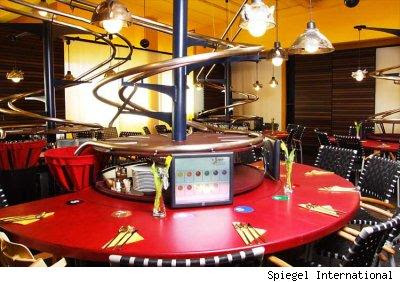
High Speed Food?

The idea is that you order your food using the 'touchscreen', pay with a 'pre-paid' plastic card, and then sit and wait for your meal to negotiate the 'helter skelter'.
It would be interesting to see how this system copes with an order for a glass of iced water and slice of lemon!!

Friday, August 24, 2007

Hungarian Goulash

Every family has it's own variation on this Austro-Hungarian dish. This is just one variation, and we are sure that it will satisfy..

Ingredients:

  • ¼ cup shortening (such as half butter and half light olive oil)
  • 4 cups of coarsely chopped onions
  • 2 lb of chuck beef, cut into 1" cubes
  • 1 small tomato. chopped
  • 1 Tablespoon paprika, make that genuine sweet Hungarian paprika SZEGED
  • 1 small green pepper, seeded and chopped fine
  • 2 teaspoons salt
  • 2 bay leaves
  • 1 cup boiling water
  • 2 large raw potatoes, cubed

Preparation:

  1. In a heavy 2½ quart saucepan heat the fat, add the onions and cook until golden brown
  2. Add the tomato, green pepper, paprika, beef and salt
  3. Cook, stirring, over medium heat until the meat loses its redness
  4. Reduce the heat and add the water, cover and simmer 1½ hours
  5. Add the potatoes and simmer until tender, about one more hour. If necessary add some water during cooking
  6. Remove bay leaves and adjust seasoning to taste

    Serve with fresh French bread and red wine.. serves 5 - 6

Your meal may not look exactly like the illustration..

Sunday, June 10, 2007

Beef Wellington.. fit for a Duke..

An introduction:

Some say it was his favorite meal, and others claim it resembled the boots that he wore. Whatever the case may be, the Duke of Wellington has a grand dish named after him, which became the entertaining extravaganza of the 1960s.

Ingredients:

  • a 3 1/2-pound fillet of beef tied with thin sheets of larding fat at room temperature
  • 3/4 pound mushrooms, chopped fine
  • 2 1/2 tablespoons unsalted butter
  • 1/2 pound pâté de foie gras (available at specialty foods shops) at room temperature
  • 1 pound puff paste or thawed frozen puff pastry plus additional for garnish if desired
  • 1 large egg white beaten to an egg wash made by beating 1 large egg yolk with 1 teaspoon of water
  • 1/2 cup Sercial Madeira2 teaspoons arrowroot dissolved in 1 teaspoon cold water
  • 1/2 cup beef broth
  • 2 tablespoons finely chopped black truffles (available at specialty food shops) if desired
  • watercress for garnish if desired

Preparation:

  1. Roast the beef in the middle of a preheated 400°F oven for 25 to 30 minutes, or until the thermometer registers 120°F.
  2. Let the fillet cool completely and discard the larding fat and the strings.
  3. Skim the fat from the pan juices and reserve the pan juices.
  4. In a heavy skillet cook the mushrooms in the butter over moderately low heat, stirring, until all the liquid they give off is evaporated and the mixture is dry
  5. Season them with salt and pepper, cool completely.
  6. Spread the fillet evenly with the pâté de foie gras, covering the top and sides, and spread the mushrooms evenly over the pâté de foie gras.
  7. On a floured surface roll 1 pound of the puff paste into a rectangle about 20- by 12- inches, or large enough to enclose the fillet completely, invert the coated fillet carefully under the middle of the dough, and fold up the long sides of the dough to enclose the fillet brushing the edges of the dough with some of the egg white to seal them.
  8. Fold ends of the dough over the fillet and seal them with the remaining egg white.
  9. Transfer the fillet, seam side down to a jelly-roll pan or shallow roasting pan and brush the dough with some of the egg wash.
  10. Roll out the additional dough and cut the shapes with decorative cutters. Arrange the cutouts on the dough decoratively, brush them with the remaining egg wash, and chill the fillet for at least 1 hour and up to 2 hours.
  11. Bake the fillet in the middle of a preheated 400°F oven for 30 minutes, reduce the heat to 350°, and bake the fillet for 5 to 10 minutes more, or until the meat thermometer registers 130°F. for medium-rare meat and the pastry is cooked through.
  12. Let the fillet stand for 15 minutes.
  13. In a saucepan boil the reserved pan juices and the Madeira until the mixture is reduced by one fourth. Add the arrowroot mixture, the broth, the truffles, and salt and pepper to taste.


The recipe is for a party of eight. Bon appetite!

Friday, April 06, 2007

Beef Stroganov.. From Russia with Taste..

Beef Stroganov, as the name suggests, hails from 19th century Russia. It was popularized in China by those who escaped the Socialist Revolution of 1917, and subsequently made popular in other parts of the world by escapees from the Chinese Cultural Revolution.
Essentially, it is a dish based on sliced beef, but any meat can be used. In Brazil chicken is substituted, and in Northern Europe it is not uncommon to find types of sausage used. The simple truth is that you can use whatever you prefer. It is also a recipe that lends itself to easy production in large quantities.
This is the ingredient list:

  • ½ pounds beef fillet, sirloin or porterhouse steak
  • Salt, ground black pepper to taste
  • 3 Tbs butter
  • 2 Tbs Olive Oil
  • 1 Tbs four
  • 1 can of drained button mushrooms (the liquid of the mushroom maybe used for thinning the sauce if necessary)
  • 1 cup beef broth or canned consommé
  • 1 teaspoon prepared mustard
  • ¼ cup sour cream, more can be used according to taste
.. and this is how you prepare it:

  1. Remove all fat and grizzle from meat, cut into narrow strips about 2" long and half an inch long, season with salt and pepper. Refrigerate for 2 hours.
  2. In a saucepan, add the olive oil and then melt 1½ Tablespoons of butter, add the flour and stir with a wire whisk or wooden spoon until well blended, heat the consommé and add all at once to the flour/butter mixture (called a roux), stir until well blended and add the mustard.
  3. In a separate saucepan heat the remaining butter, add the meat and brown quickly all around.
  4. Add the sour cream to the sauce and heat well, constantly stirring.
  5. Add the mushrooms.
  6. Pour the sauce over the meat, adjust salt and pepper according to taste. Stir it reasonably well.
It would traditionally be served on a bed of rice or noodles, but would be as fine a treat with potatoes, Duchess perhaps, and green vegetables.


Please note that your finished product may not look exactly like the picture.

Friday, March 23, 2007

How to Brew a Cup of Green Tea, and more..

Producing the perfect cup of green tea is a tricky process. If not handled properly, those same polyphenols that provide health benefits can ruin the flavor, making the tea taste "gassy." It's particularly important not to over-brew. While it's best to follow the manufacturer's instructions for each variety of green tea, here are some general instructions:
  1. Use one tea bag, or 2 - 4 grams of tea per cup (one to two teaspoons, depending on the variety of green tea you are brewing).
  2. Fill a kettle with cold water and bring to a boil.
  3. After unplugging the kettle, allow it to stand for up to 3 minutes.
  4. Pour the heated water over the tea bag or tea, and allow it to steep for up to 3 minutes. If using a tea bag, remove the bag.
  5. Allow the tea to cool for three more minutes.

OK, so now you know how to do it. Let us move on to why you should do it.

Green tea is rich in catechin polyphenols, particularly epigallocatechin gallate which is a powerful anti-oxidant. It inhibits the growth of cancer cells, it kills cancer cells without harming healthy tissue. It is also effective in lowering LDL cholesterol levels, and inhibiting the abnormal formation of blood clots. The formation of abnormal blood clots is the leading cause of heart attacks and stroke. Green tea consumption can help with:

  • cancer
  • rheumatoid arthritis
  • high cholesterol levels
  • cardiovascular disease
  • infection
  • impaired immune function

Red wine contains an anti-oxidant called resveratrol, a polyphenol that limits the negative effects of smoking and a fatty diet. The French and Spanish like their red wine, and it has served them well. There is far less incidence of health problems related to an over-rich diet in France, the home of over-rich food, than there is in the USA.

Smoking is almost a national pastime in France, Spain and Japan, and yet the health related problems in these countries are substantially lower than almost anywhere else.

There are a few web sites that cover the above topic. I will leave you to draw your own conclusions. I will say this though. Of all the places I have travelled, I have seen less amounts of obviously infirm people in France or Spain than I have seen anywhere else. I have not travelled the Orient, so do not have first-hand experience of the area, but I understand that people there live to be older and healthier a whole lot more than in other parts of the world.

Wednesday, March 21, 2007

An Austrian Dessert - Linzer Torte

Kaffee-Trinken is a social ritual at a Konditorei, Kaffeehaus, or in the relaxed atmosphere of one's own living room around a Kaffeetisch laid with flowers and the hostess's elegant porcelain especially designed for such cherished afternoon get-togethers. What better than to serve up this most delicious pastry.

Ingredients

  • 1 1/2 sticks butter plus 1 tablespoon
  • 1/2 cup sugar
  • 1 tablespoon honey
  • 1 tablespoon orange zest
  • 1 teaspoon cinnamon
  • 1 teaspoon Chinese Five Spice (cinnamon, nutmeg, allspice, clove, star anise)
  • 1 egg
  • 5 ounces of hazelnuts, toasted and ground
  • 1 3/4 cup all-purpose flour
  • 1 1/2 teaspoons baking powder
  • Pinch of salt
  • 1 cup raspberry jam (or your favorite type of jam)

Directions

  1. In a standing electric mixer fitted with a paddle attachment, cream together the butter and sugar on medium speed for 2 to 3 minutes. Scrape down the sides and add honey, zest, cinnamon and spices. Continue mixing for one more minute. Scrape down the sides and add egg. Mix again until well blended.
  2. Sift the dry ingredients together. On low speed, add the sifted dry ingredients to the butter mixture and continue to mix until a dough is formed.
  3. Remove the dough from the mixer, wrap in plastic film and refrigerate for about 2 hours.
  4. Butter the bottom and sides of a 9-inch cake pan. Line the bottom of the pan with wax or parchment paper. Remove dough from the refrigerator and divide in two. Dredge the work surface with flour and with a rolling pin, roll out the dough to 1/2-inch thick, forming a 12-inch circle. This will be for the bottom of the torte. Line the bottom and sides of the prepared cake pan with the circle.
  5. For the top of the torte, use the second half of dough, roll it to 1/2-inch thick to create a 9-by-12-inch rectangle. Refrigerate both the top and bottom for about 20 minutes.
  6. Remove from refrigerator and fill bottom half with raspberry jam.
  7. Preheat the oven to 350 degrees F.
  8. Create a lattice with the rectangular piece of dough by cutting 12 9-inch strips. (Use a piece of cardboard to build the lattice to make it easy to slide the lattice onto the bottom of the torte.) Slide the lattice onto the jam-filled bottom. Fold the edges of the dough up and over the top of the torte.
  9. 9. Bake in oven for 30 to 35 minutes until golden brown.

For a holiday accent, sprinkle with confectioners sugar. And of course, Linzer Torte is always served with whipped cream!

Fantastisch!

Monday, March 12, 2007

A Tale of Two Peas..

Once upon a time there was a mad rush to eat peas. Not any old peas mind you. These were special peas in that they were picked early. Approximately three inches long these early pickings were known as 'Mangetout' in Europe and 'Sugar Snaps' in North America. So what was wrong with the standard pea? This rhyme sums it all up..

"I eat my peas with honey
I've done it all my life
It makes the peas taste funny
But it keeps them on the knife! "

The British developed the art of mixing in peas with copious amounts of mashed potatoes. Youngsters added Tomato Ketchup for reasons only known to themselves. Gravy was often thickened to the point where it would hold peas together in molecular forms, while others would try to balance peas on top of whatever else was on the fork. From serving to eating peas were messy. But of all vegetables peas are the most universally accepted. Even the most ardent vegetable hater can usually manage peas.

There was a minor revolution starting in the 1970's and '80's. This was the era of 'Nouvelle Cuisine' where food had to be light and tickle the taste buds. It had to be visually appealing too. Paté transformed from the usual murky brownish colours to something akin to Neapolitan ice cream. Thick gravy was replaced by 'sauces', delicately applied with 'icing bags'. Tomato Ketchup was a no-no and the majority of vegetables were far too ugly to adorn a plate of this new style cooking.

All of course, except for the venerable pea. Not loose peas rolling around uncontrollably, landing on table cloths, the laps of diners, and the floor. This was a new pea, a young pea, so young that it could not easily be removed from it's pod, but still having the fresh, light taste of a good podded pea. Peas without all of the mess. Peas that could be arranged in pretty patterns.

Anyway, a supermarket chain in the UK was employing Africans in various villages to grow and pick these 'new' peas. Nouvelle Cuisine had popularized these things to the point where it was the 'in' thing to eat with almost any meal. The Africans were so pleased with getting paid for growing and picking these peas, that they made up a song such that every time Mr Tesco (a company representative actually, but they cared not) paid them a visit, they would perform it along with normal tribal dances.

Then one day, Mr Tesco arrived and told them that they would only get paid for peas of a certain length because equal sized peas looked better in the customer packaging. They still sang their song, not fully understanding the implications of demands being made. When it came time to pack the harvest most of the peas were not acceptable, and the people of the villages were hardly paid a 'bean' for their efforts. The words to the song were quickly rewritten, and instead of reflecting praise and adulation for Mr Tesco, the words gave some ideas as to what Mr Tesco could do with the peas, regardless of size.

At about the same time, diners were also getting tired of paying big bucks for tidbits of food and hellishly over-priced table wine. The honeymoon was finally over. The 'new' peas can still be seen in food stores, but only the more adventurous still eat them. Like fries they are more easily eaten by hand, being too thin for a fork to get a hold. They are positively disgusting when eaten with honey, and they do not mix well in mashed potatoes. Mangetout are the last vestige of an attempt at healthy eating that went seriously wrong way back in some African villages.

Monday, March 05, 2007

A Couple of Observations..

This is a reference to the recipe for a simple, easy to prepare, yet very tasty meal, Shrimp Creole. For those not 'au fait' with some terminology, I will explain.

The term 'Creole' as understood in the Southern US is an English word derived from the Castillian-Spanish and French words 'criollo' and 'crèole' respectively. Creole people are essentially those born of either Spanish or French parentage in a Spanish or French colony. Creole people tend to try to hold on to their ancestral heritage by whatever means, and cuisine is but one facet.

Creole is also a term used in other parts of the world, and has now become the way of describing anybody born in a colony, essentially a person of such mixed heritage as makes it impossible to determine exact and original roots.

Now to the second observation.

You may notice that there is reference to a sauté pan in the recipe. A sauté pan is a shallow sided cooking pan where the sides of the pan are vertical to the base, and the base is heavy (often copper) and very flat in order that heat distribution across the base is as even as possible.

Frying pans have sloped sides such that food can be moved around in and out of the high temperature zone in the middle of the pan. The most extreme version of the frying pan is the 'Wok' used in the preparation of Oriental cuisine.

Note that in the US, the word 'skillet' is used. This has become a generic term for all of the pans mentioned.

Friday, March 02, 2007

Shrimp Creole..

This is a popular and easy Southern US dish.

Ingredients required..

  • 2 lb shrimp, shelled and de-veined
  • 3 red peppers, cut into pieces
  • 3 onions, cut into small pieces
  • 3 large tomatoes, peeled and cut into pieces
  • ¼ cup of good olive oil
  • 3 garlic cloves, minced
  • Salt and white pepper
  • Chopped parsley
  • Enough boiled rice to serve 4

.. And this is how you prepare it..

  1. Heat the oil in a sauté pan
  2. Add onions and cook until golden
  3. Add peppers, cook until soft, about 10 minutes
  4. Add the tomatoes, heat and stir until hot enough to add the shrimps
  5. Keep stirring until shrimps are cooked, about 2 minutes
  6. Adjust flavor with salt and pepper
  7. Sprinkle with parsley
  8. Serve in a dish along with the rice and soy sauce and plenty of French bread to soak up the delicious sauce.

Enjoy..

A Restaurant for the Brave..

Hilton have opened a new restaurant called 'Ithaa'. I know what you are thinking, because the very same thought passed through my mind too. 'Who cares'? Unless it is within easy driving distance, I don't go there, and this one most definitely isn't just down the road from me. It is at the Hilton Maldives Resort & Spa, Rangali Island in the Maldives.

Of course, distance is not the only barrier. This is no 'tuxedo and bow tie' establishment or, for that matter, casual dress. This is 'scuba gear and flippers' dress if you ask me. The restaurant is 16 feet below sea level, access gained by a spiral staircase. If you don't kill yourself just getting into it, your waiter or waitress could while trying to get the various courses to you.


They say that the menu is typical of high class city 'joints', but that the view will probably take your mind off of the food anyway. Excuse me? It would take more than a few fish and a five star menu to take my mind off looking for leaks.


This restaurant is reputed to have cost $5 million, and it only seats 14 at any one time! Somebody should have told them that it would be possible and cheaper to build a 14 seat diner on land, place four underwater cameras in a small glass bubble, and transmit the pictures to large plasma screens affixed to all of the walls.

Tuesday, February 13, 2007

A Popular French Dish.. Boeuf Miroton

The ingredients:

  • 2 lbs. cold cooked beef (eye round, rump roast for instance)
  • 4 thinly sliced onions
  • 4 Tbsp. butter
  • 4 cups brown sauce
  • 1 cup Madeira wine (optional)
  • 4 Tbsp. tomato sauce or juice
  • 4 Tbsp. butter
  • 4 Tbsp. flour
  • 4 cups of beef stock (any instant bouillon works fine)
  • 4 Tbsp. tomato juice

Preparation and cooking:

  1. Cut the beef into thin slices, set aside..
  2. Cut the onions into thin slices and sauté in the butter until golden and soft
  3. Make a brown sauce.
  4. Take a large casserole and layer the onions and beef in it, starting with the onions.
  5. Pour the brown sauce over it, make sure it is sufficiently covering the meat.
  6. Bake in a 350ºF until very hot and bubbly

The dish improves greatly when prepared the day before. Serve with potato puré and French bread and a salad. Serves easily 4 and leftovers are even better.

VOILA!

For the rest of the setting, you will require two single candles and candlesticks, an antique lamp, some dried flowers, a vase, and a panache for still life settings. Our thanks to the chef and photographer for making food look so good..

Saturday, January 27, 2007

The Five Second Rule..

This is a picture of Escherichia coli, better known as E-Coli 0157. It exists in the stomachs of cattle and sheep, and is easily passed down the food chain by improper meat handling procedures. People can develop serious illness from this strain of E-Coli, and some die from its effects.

You don't want to know how many will fit onto a pinhead.

Always use a clean surface for food preparations. Make sure no items such as handbags, pet food dishes, shopping bags etc have been temporarily in touch with the surface. Tools like cutting boards and knives should be ready to be used to avoid opening drawers at the last minute. Grocery stores carry disposable cleaning towels and plastic gloves. Wiping surfaces with a damp cloth is not an answer. This action only serves to spread and enhance the bacteria reproduction rate. Avoid sponges or re-usable cloths for clean-up. Use disinfecting disposable towels for jobs like that.

If you drop food onto the floor, THROW IT OUT. E-Coli 0157 and its relatives have no concept of time. The Five Second Rule is a myth, as are the three, seven and ten second rules. Bacteria instantly attach to whatever surface is acceptable. There is NO safe period of time.

Tuesday, January 23, 2007

The Greek National Dish..

Moussaka (Lamb-Eggplant Casserole)

This is a real Greek recipe
  • 3 medium eggplants
  • 1 cup good olive oil
  • 1 cup butter
  • 3 large onions, finely chopped
  • 2 pounds lamb (beef or half and half can be substituted)
  • 3 Tbsp. tomato paste
  • ½ cup red wine, optional
  • ½ cup chopped parsley
  • ½ teaspoon cinnamon or to taste
  • salt to taste
  • freshly ground pepper to taste
  • 6 Tbsp. flour
  • 1 quart milk
  • 4 eggs, well beaten
  • freshly grated nutmeg
  • 2 cups ricotta or farmers cheese
  • 1 cup fine breadcrumbs
  • 1 cup freshly grated Parmesan cheese
  1. Peel eggplants and slice about ½" thick, brown quickly in the oil
  2. Add 4 Tb butter and sauté the onions until golden in the same skillet
  3. Combine tomato paste with the wine, parley, cinnamon, salt and pepper
  4. Stir this mixture into the meat and simmer over low heat stirring frequently until all liquid is absorbed.
  5. Remove from heat.
  6. Preheat oven to 375º
  7. Make a white sauce by melting 8 Tbsp. butter and blending in the flour, stirring with a wire whisk.
  8. Bring the milk to a boil and add it gradually to the butter-flour mix, stirring constantly, when thick and smooth set aside and cool slightly.
  9. Stir in beaten eggs, nutmeg and ricotta
  10. Grease a 11x16 casserole or round dish and sprinkle with crumbs
  11. Arrange in layers eggplant and meat sauce, sprinkle layers with Parmesan and bread crumsbs, pour the ricotta cheese sauce over the top and bake 1 hour until golden on top.

If you let it stand over night, the flavor improves when reheated.
Serve with crusty bread and the same wine you used in the dish.
This sounds a bit difficult, but is actually not so, and in any case worth the effort.


As promised..


Sunday, January 14, 2007

The Italian National Dish..

PIZZA!

Pizza Capricciosa: This is based on the Pizzaria Giancarlo, outside Florence's Porta San Frediano.
  1. 1/2 cup tomato sauce or chopped canned tomatoes
  2. 1/4 pound shredded mozzarella
  3. 4-6 green or black olives (stoned) sliced thinly
  4. 6 small mushrooms sliced thinly
  5. 1 link sweet Italian sausage (about 2 inches long), skinned and shredded
  6. 8 thin slices salamino piccante (pepperoni in the anglo-saxon world)
  7. 2 ounces thinly sliced ham, shredded
  8. 2 canned artichoke hearts, quartered

Spread the tomato sauce over the pizza, sprinkle the remaining ingredients over the sauce, drizzle with a few drops olive oil and bake. For the very best pizza, always use a thin base. There is little worse than eating a pizza that has the consistency of carpet.

You can of course use any kind of ingredient in place of the Salamino Piccante, ham and Italian sausage. Try it with anchovies, prawns and/or mussels.

Sunday, January 07, 2007

Marmite..

An unholy coloring and salty, harsh taste places Marmite at the top of the 'acquired taste' list. More British than fish and chips, Marmite is a by-product of beer brewing, essentially yeast extract and full of vitamin B. It really is good for you, and I should know. I was a 'Marmite' baby, brought up on the stuff. Of course, non-Brits never quite know what to do with it, so here are a couple of hints.

Toast some good quality white bread (it has to be always white), butter it while still hot, and then spread some Marmite very thinly across the toast. Now cut it up into strips, 3/4in wide, and you have the British delicacy known as Marmite Soldiers, a variation on plain Toast Soldiers, ideal for dipping into a soft boiled egg.

For those of you who like potato chip sandwiches, another Brit delicacy, again use white bread and real butter (salted), spread Marmite thinly, and add plain potato chips as required. Now 'sandwich' the Marmite, butter and potato chips between another piece of buttered white bread.

Marmite is an accredited 'Vegetarian' product, and also approved as a Kosher product, even though not strictly 100% Kosher.